
ABB AMK500 rotor connection and wiring retrofit
OREMOTOR turned accumulated workshop experience into proprietary kits, dedicated components and a repeatable technical instruction for rotor connections.
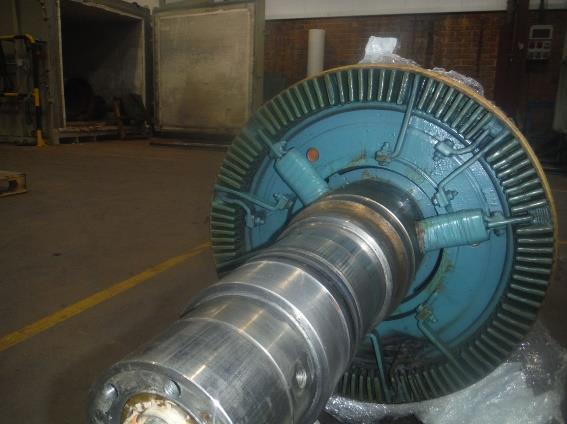
From recurring failures to a 95 mm² standard
Repeated failures in ABB AMK500 star connections, bridges and rotor wiring showed that repairing only the damaged point was insufficient. OREMOTOR brought together workshop evidence, developed connection kits, collaborated technically with Vestas and converted this experience into a dedicated installation instruction using 95 mm² wiring.
The work evolved between 2022 and 2024 through in-house processes, tooling and parts for different variants. Years later, Iberdrola’s 2026 technical specification made replacement of 70 mm² wiring with 95 mm² mandatory for this model, aligning with the criteria OREMOTOR was already applying in its repairs.
The challenge
Historical documentation brings together five specific AMK500 failure cases: four in the star-connection ring and one in the bridge connection. They do not represent a fleet-wide failure rate, but demonstrate sufficient recurrence to justify an improvement project.
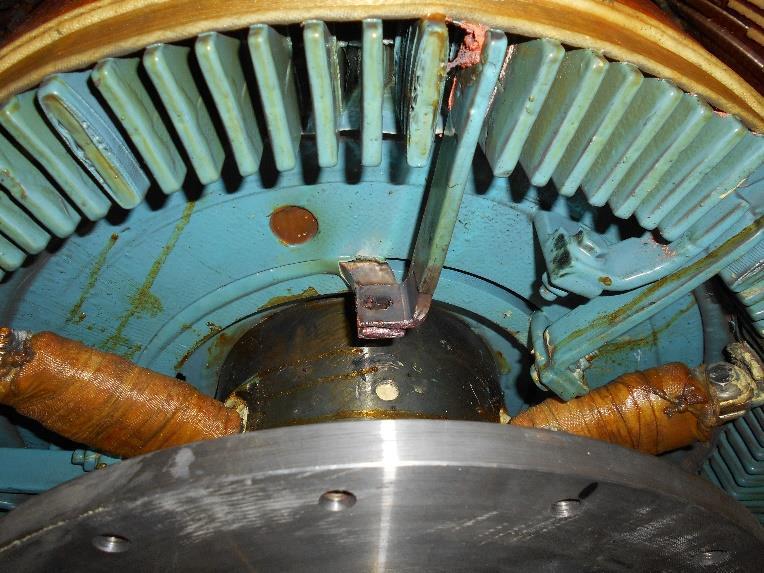
Reliability also depends on more than cable size. The system includes connections, terminals, routing through the shaft, positioning, fastening, restraint, insulation and final inspection. Resolving one point while leaving the others uncontrolled would have maintained variability between repairs.
OREMOTOR engineering
OREMOTOR addressed the problem through product and process engineering. It developed wiring and connection kits, increased the cross-section to 95 mm² and defined the operations needed for consistent installation. The solution also includes in-house components for different configurations, including an H-shaped connection developed for the V3 variant.
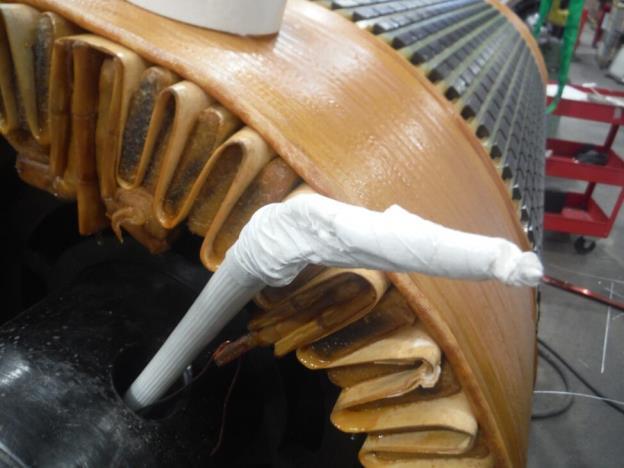
The design is supported by workshop experience and a real campaign with Vestas in 2022. Three generators fitted with OREMOTOR kits passed the documented tests, and the OEM gave positive feedback on the collaboration. The AMK500 was also selected as a priority model for a rotor-connection failure analysis programme developed with Tecnalia.
From a one-off solution to an industrialised process
Initial experience became a dedicated technical instruction created in May 2023 and revised in January 2024. Its twenty pages standardise materials, tooling, preparation, installation, joining, restraint, insulation and checks. Details are deliberately summarised for this public presentation: the key point is that the move to 95 mm² forms part of a repeatable working system, not just a cable replacement.
Drawings for in-house components and development across variants complete the transition from a corrective response to an industrialised solution.
Key figures
- 5: AMK500 failure cases documented as the basis for analysis.
- 3: generators tested with OREMOTOR kits in the 2022 Vestas campaign.
- 95 mm²: standardised rotor wiring cross-section.
- 2023 / 2024: creation and revision of the technical instruction.
- 2026: the change from 70 to 95 mm² appears as a requirement in Iberdrola’s specification.
Results and validation
Available traceability confirms five reference failures, three units tested in the 2022 Vestas campaign, a dedicated technical instruction and subsequent development of in-house components. In 2026, OREMOTOR internally documented accumulated experience covering 39 units; this figure remains outside the public KPIs pending an individual register by work order and serial number.
Iberdrola’s May 2026 technical specification requires 70 mm² rotor cables to always be replaced with 95 mm² cables on the 2 MW ABB AMK500L4A. This decision is not attributed to OREMOTOR. What can be stated is that the operator’s requirement aligned with a solution OREMOTOR had been applying and documenting for years.
What this project demonstrates about OREMOTOR
This case shows how OREMOTOR uses fleet experience to recognise patterns, expand the scope from the failed component to the complete system and turn learning into instructions, tooling and in-house parts. Repair thus becomes cumulative industrial knowledge rather than an isolated response.
A recurring problem with a wind turbine generator?
Share the model, history and failure mode. Our team can assess an industrially deployable repair solution.