
NDE retrofit for ABB AMK500 generators in Vestas wind turbines
OREMOTOR transformed a sensitive slip-ring system configuration into a machined, controlled and repeatable assembly for different rotor versions.
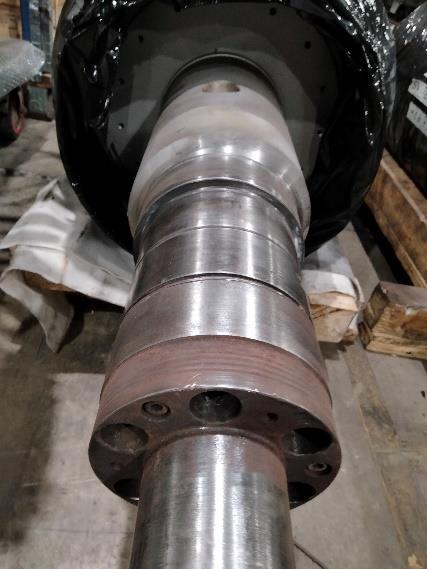
From a geometric deviation to an industrially deployable solution
In certain ABB AMK500 generators installed in Vestas wind turbines, the non-drive end (NDE) included a separate sleeve associated with the slip-ring system. A loss of stability or concentricity in this area could cause radial runout incompatible with the precision required of a high-speed assembly.
OREMOTOR turned this geometric problem into a repair engineering project: redesigning the component, integrating it rigidly with the shaft and defining a complete assembly, joining, machining and verification process. The solution was industrialised in 2023 and subsequently developed to cover V1, V2 and V3 variants.
The challenge
The problem originated not in a major visible fracture but in a seemingly secondary mechanical interface. The independent sleeve or insert at the NDE could lose concentricity or stability relative to the shaft. Around the slip-ring system, small geometric deviations can compromise assembly performance and make a lasting repair difficult.
Different rotor configurations added complexity: replacing a component was not enough. Each version had to be identified, functional surfaces preserved and the final geometry controlled after joining and machining.
OREMOTOR engineering
OREMOTOR developed a solution that removes reliance on a separate component and makes the new insert an integral part of the shaft. The project combines variant identification, dedicated manufacture, controlled-fit assembly, joining to the shaft, final precision machining and dimensional and geometric verification.
The solution’s value lies in controlling the entire process. The sequence was designed to restore NDE functionality and ensure system concentricity while protecting the manufacturing parameters and details that form part of OREMOTOR’s know-how.
From a one-off solution to an industrialised process
The first industrial implementation was documented in November 2023. The improvement was then formalised through procedures, version-specific drawings, dimensional records and acceptance criteria. Final verification includes a radial runout limit of less than 0.025 mm.
Workshop experience also helped the standard evolve. After analysing a V3 version with a previous weld unrelated to the improvement—which was subsequently found to be superficial—OREMOTOR applied its solution and proactively extended the retrofit criteria to that configuration.
Key figures
- 2023: industrialisation of the solution.
- 31: work orders/interventions reconstructed for the retrofit period.
- 27: unique physical generators in the audited register.
- < 0.025 mm: final radial runout criterion.
- V1 / V2 / V3: documented development across variants.
Results and validation
The dossier reconstructs 31 interventions involving 27 unique physical generators during the retrofit period. These figures do not represent 27 jobs of identical scope, but the real experience base used to continue controlling and refining the solution.
The approach was shared and reviewed with Vestas, which responded positively to the technical approach and speed of implementation. Documentation, geometric control, version-specific adaptation and accumulated experience support the central result: OREMOTOR turned a recurring shaft-end problem into a repeatable, verifiable mechanical solution.
What this project demonstrates about OREMOTOR
This case demonstrates OREMOTOR’s ability to identify the functional cause of a deviation, redesign a critical interface and turn repair into an industrial process. It also shows discipline in documenting variants, learning from new evidence and collaborating technically with the OEM through in-house workshop engineering.
A recurring problem with a wind turbine generator?
Share the model, history and failure mode. Our team can assess an industrially deployable repair solution.